Queensland’s landmark parliamentary inquiry into e-mobility safety and use – covering e-bikes, e-scooters and other personal electric transport – is poised to deliver recommendations that could reshape how Queenslanders ride, regulate and think about powered bicycles. The inquiry, established in mid-2025 and drawing more than 1200 submissions, is widely expected to recommend minimum age limits and potential licensing requirements for e-bike riders.
As the state prepares to respond to the committee’s findings, e-bike advocates and industry groups have been vocal about both the promise and the limitations of these reforms.
What the inquiry leak suggests…
At the centre of the discussion is a proposal – backed by some inquiry committee members and health stakeholders – to ban e-bikes and e-scooters for riders under 16, and require riders over 16 to hold at least a learner driver’s licence before using one legally. A leaked report from the inquiry earlier this week cites concerns around rising injuries, fatalities and hospital admissions tied to personal electric transport.
These suggestions reflect increasing public pressure following high-profile incidents and rising safety data, but they also underscore a fundamental tension: balancing safety with access. We caught up with Bicycle Queensland’s Andrew Demack on the State advocacy group’s thoughts on the inquiry, and what it means for mountain bikers.
Bicycle Queensland’s Stance
For organisations like Bicycle Queensland, the inquiry has highlighted deeper systemic issues around regulation, import standards, and enforcement.
As Andrew Demack, Director of Advocacy from Bicycle Queensland told us, “Linking e-bike usage to driver licences makes little sense. That’s a system designed to show you’re safe to drive cars – it doesn’t equip people to ride e-bikes.”
He described the licensing proposal as “less than ideal” and argued that it misses the point of the debate: ensuring bikes are legal and safe from the outset.
“A far better outcome is to make sure all bikes available are compliant with the recognised standard – not require a licence to ride what is essentially a bicycle,” Demack said.
He also expressed concern about proposals to bar under-16s from riding e-bikes.
“There’s no strong evidence to show that a legal pedelec that meets standards is more dangerous to teens than a regular bike. It’s those illegal, high-powered conversions that are a real problem.”
Queensland’s Current E-Bike Rules
Under current Queensland law, an e-bike is considered legal only if it meets specific technical requirements:
- It must be pedal-assisted, meaning the motor only assists when you are pedalling, and assistance cuts out at 25 km/h.
- The motor’s maximum continuous power output must not exceed 250 watts, with a limited throttle assist up to ~6 km/h.
- Legal e-bikes must comply with the European Standard EN 15194, often indicated by a compliance sticker on the frame.
- No licence, registration or insurance is required to ride a compliant e-bike.
- Devices exceeding these limits – such as motors over 250 W or throttle-only systems capable of higher speeds – are considered illegal to operate on public roads and paths and can attract fines, impoundment and enforcement action from police.
Despite these rules, one of the inquiry’s key themes was the wide availability of “grey-market” e-bikes – high-powered models sold with software-limited settings but still capable of greater output. Regarding e-MTB’s, Demack states:
“Manufacturers are racing each other to have extra power, but the standard is about what’s appropriate for shared public spaces – not peak wattage on a mountain climb.”
This puts legitimate e-MTBs in a nuanced position. Many e-MTBs sold by major brands, while marketed with peak power figures above 250W, are designed and controlled such that their continuous power and assist behaviour complies with EN15194 while still delivering the ability to crush even the steepest of off-road gradients. That’s how they remain legal as bicycles in Queensland – the critical measures are continuous power and assist cut-off behaviour, not peak power figures seen in marketing materials.
Implications for E-MTB riders
Here at AMB we believe that all bikes are cool, but as a mountain biking publication, we are particularly interested in what implications this may have for fellow e-bike forest-dwellers. It’s important to note if recommendations get enacted, then other states may introduce similar restrictions – so it’s not just Queenslanders that need to keep an eye on this inquiry.
The most important implication of the age and license-restriction that’s likely to be handed down by the inquiry is access: it’s a blanket ban that restricts access to legitimate users. A very blunt tool.
Sure, we think kids should ‘earn their turns’, but the reality is that if there are kids using e-bikes to get out on the trails that would otherwise not engage in activity then that’s a win. This is especially true when considering the legal limits are reasonably conservative – 250W is not a huge number for continuous power, and 25km/hr is hardly the speed of light. Illegal throttle assist bikes? That’s an entirely different question, and one that deserves governmental response as to how they’re managing illegal e-bikes (because by and large, they’re not – but perhaps that would be a great first step before blanket bans).
There are also discrete situations that become infinitely more complex if access is restricted – in the case of a family where multiple individuals are using the same bike. If a 15 year old wants to head out on mum or dad’s legal e-bike, they can’t.
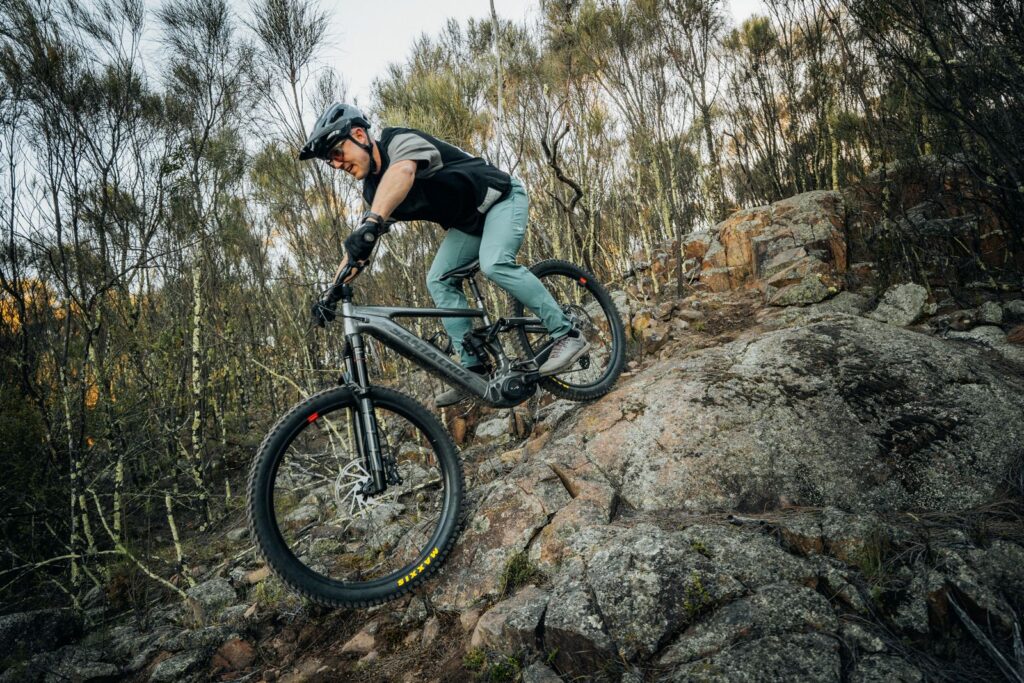
The state of the bicycle industry, like many others, took a blow during the post-COVID-19 years, where we witnessed a boom and bust situation based on faulty projections of infinite growth. Where we see key growth in 2024/5 is the sales of e-bikes.
And finally, we can’t deny that e-bikes aren’t just supporting the bicycle industry’s recovery, they’re also reducing barriers to access for many Australians who are aiming to live healthier, more fulfilled lives. Whatever your personal stance on e-bikes vs analogue bikes, it’s undeniable that more people on bikes allows greater potential for increased trail development, increased governmental spending on bike infrastructure, increased individual and community quality of life and decreased chronic health conditions as a byproduct of increased exercise. Anything that reduces access to recreational cycling has a ripple effect through many layers of society.
We would welcome the data that correlates legal e-bikes with increased accidents and increased injury severity that could justify Government restriction of legal e-bikes, but to us at AMB it looks like the systemic issues that have created the ‘e-bike issue’ haven’t been addressed, and instead of the difficult task of getting illegal rides off the roads and trails, they’ve decided to instead tighten restrictions for everybody.
Final Thoughts: Safety vs. Access
The parliamentary inquiry has sparked a vital conversation about how Queensland and Australia regulate a rapidly growing mode of transport. Proposals to restrict youth access or link e-bike use to licences reflect genuine safety concerns — but they also risk sidelining an otherwise accessible, low-emission transport option if the focus remains on symptoms rather than structural fixes.
As Bicycle Queensland’s Andrew Demack put it, “If we don’t address the flood of illegal devices and clarify standards, none of these recommendations will truly fix the problem.”
Australia’s State-by-State E-Bike Laws
While most of Australia aligns around a core 250W/25 km/h framework rooted in EN15194, there are important differences across states and territories:
Queensland
- Pedal-assist e-bikes with maximum continuous power of 250 W and cut-off at 25 km/h are legal without a licence or registration.
- Throttle use is allowed only for start-assist up to ~6 km/h.
- High-powered or purely throttle-based bikes are illegal and treated as unregistered motor vehicles.
New South Wales
- Recent reforms have aligned NSW with a 250W power limit and require batteries and devices to be independently certified.
- The state is also moving toward age-related restrictions and powers for police to seize illegal machines.
Victoria
- Follows the 250W/25 km/h rule.
- E-bikes are classed as bicycles and do not require licence or registration.
Western Australia
- E-bikes must meet the 250W limit, and riders must be at least 16 to engage the motor.
South Australia
- 250 W/25 km/h requirements apply to e-bikes for legal use on roads/paths.
Tasmania, ACT & Northern Territory
- These regions also follow broadly similar rules for e-bike legality, with minor differences in throttle allowance and definitions.
Non-compliant devices can attract fines (Queensland fines for unregistered/illegal use can exceed $1,640), impoundment, and other penalties across states.