
The battle over the merits of zone 2 (Z2) training has been raging for a couple of years now! It’s been a click bait debate between esteemed coaches, physiologists and bro science influencers trying to prove whether or not Z2 training is the one size fits all Nirvana training zone that is key to high performance as well as health and longevity!
Thankfully this year a couple of key scientific papers have dropped to calm the farm and update the endurance training community with rigorous insight into Z2 training. This article examines those papers in order to highlight three very different viewpoints on Z2 training before suggesting what might work best for you, the highly esteemed AMB reader and mountain bike rider/racer.

The first article, What is “Zone 2 training”?: Experts viewpoint on Definition, Training Methods and Expected Adaptations, Sitko et al, (2025) seeks to clarify Z2 training in exactly the way the title suggests, with 14 of the world’s highest profile sports scientists and professional coaches defining Z2, giving some examples of Z2 training and how this training creates adaptations.
The second paper I will discuss has the hefty title: Much ado about Zone 2: A Narrative Review Assessing the efficacy of Zone 2 Training for Improving Mitochondrial Capacity and Cardiorespiratory Fitness in the General Population, Storoschuk et al (2025).
Read more fitness guides from AMB:
– High intensity interval training guide
– E-Enduro training with Ryan Gilchrist
– Listening to your body through the bike
While Sitko et al’s article helps us understand the efficacy of Z2 training for elite athletic populations who train 25+hours per week, Much ado About Zone 2 provides welcome insight into zone 2 training for the general population which might be more relevant for the AMB reader who rides a bit on weekdays and weekends and rocks the occasional race each year.
And although not a peer reviewed article I am also going to provide some insights from Dr Stacy Sims with her views on Z2 training for women in her article titled What women need to prioritise instead of Zone 2.
Let’s unpack the studies more.
Defining zone 2 training
The 14 experts in Sitko et al’s study define Z2 as the second zone in a five-zone model. Coaches and sports scientists use zones to define different intensities of exercise, often starting from the easiest intensity and concluding at the hardest.
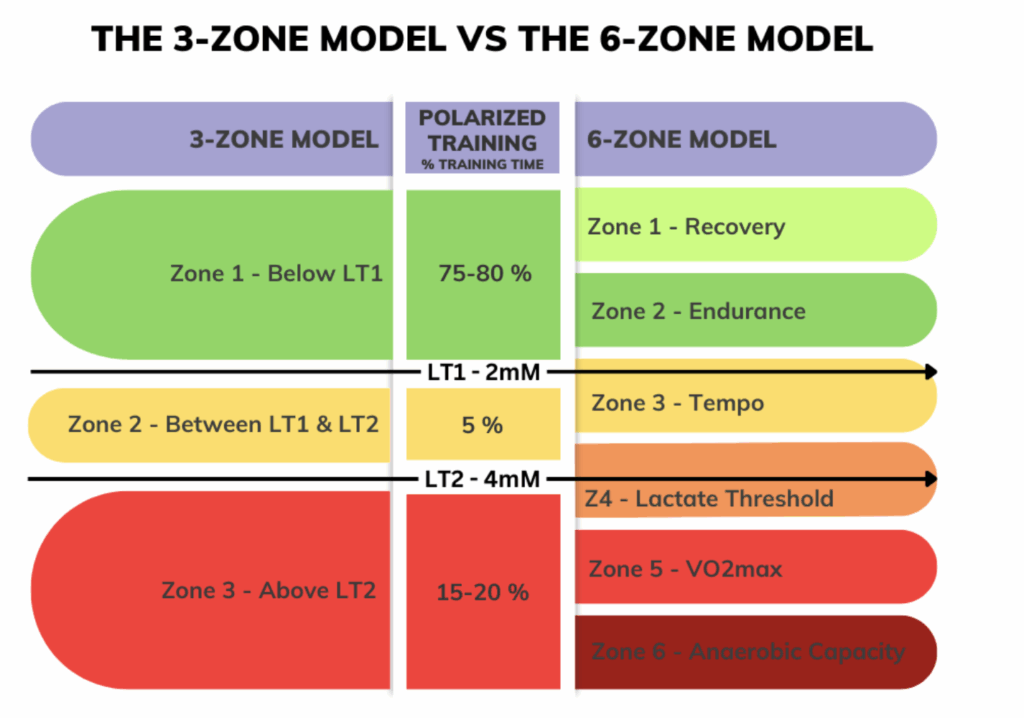
Sitko et al defines Z2 training as a low intensity endurance training zone just below Lactate Threshold 1 (LT1) that is a foundational zone in training endurance. When riding in Z2 a cyclist will experience minimal changes in blood lactate (1 – 2mmol/L), a stable heart rate and low rate of perceived exertion.
Storoschuk et al divides exercise intensity into three zones – moderate (Z1), heavy (Z2), and severe (Z3), and confusingly places Z2 training into the moderate intensity domain, which ends up Z1 on a three-zone model!) This article describes Z2 training mostly using fat as fuel, with low rates of glycogen (carbohydrate stored ready to use fuel in the liver, blood and muscles) use, and the capacity to maintain a comfortable conversation while cycling in Z2.
Sims builds on this definition of Z2, agreeing with Storoschuk et al that Z2 uses fat as a fuel and also trains the body’s efficiency to do so, while sparing glycogen for use during higher intensity exercise as well as improving the body’s metabolic flexibility ie the ability to switch between using fat to fuel low intensity exercise and carbohydrate to fuel high intensity exercise.
With so many adaptations from riding slowly at low intensity, you can see why zone 2 is sold the way it is as the wonder zone for improving cycling performance!
How should zone 2 training be done?
Sitko et al explains that Z2 training can be done three ways
- Continuous with sessions ideally longer than 2 hours.
- It can be varied to include short intervals of zone 1 or recovery
- Integrating Z2 into recovery periods between zone 4 threshold efforts or zone 5 vo2 efforts. Or putting Z2 at the start of a session for a prolonged period and then intervals towards the end to build a rider’s durability.
Storoschuk et al doesn’t go into depth to describe Z2 training, while Sims describes Z2 training as being >45min. Z2 is an intensity that can be undertaken for hours on end, and current health recommendations to do three to four Z2 training sessions a week.
What training effects does Zone 2 training have?
Increased Muscle Capillarisation: Capillaries surround the muscles and facilitate the exchange of oxygen from the blood to the muscles. z2 training increases the surface area of the capillaries leading to improved delivery of oxygen to the muscles which will contribute to improving vo2 and endurance performance overall.
Mitochondrial Biogenesis: You would’ve heard that the mitochondria are the powerhouse of the muscle cell! Simply – mitochondria produce ATP which is used to power the contraction and relaxing of muscle cells during exercise. Z2 training increases the number and size of mitochondria hence increasing the amount of ATP that can be produced leading to more energy availability during physical activity.
Improved Power at LT1: Because Z2 training occurs close to Lactate Threshold 1 (LT1) our body, which is wonderful at adapting to stress/load, becomes more efficient through training. After some time training in Z2, cyclists will notice they are producing the same power numbers but at a lower heart rate, or be able to ride familiar roads, trails or hills with ease. This means their body has become more efficient, using limitless supplies of fat for fuel (fat oxidation) at low intensity and saving limited supplies of glycogen for hard efforts at high intensity.
Is zone 2 the only training to create these adaptations? Three very different perspectives
Sitko et al advocates strongly for Z2 training. That makes total sense – these coaches and sports scientists live in a world where professional athletes train and recover with almost zero limitations on the amount of time they can train each week. It’s impossible for professional athletes, no matter their physical capacity, to spend all of their 20–30+ hours a week training at high intensity. They would be cooked (overtrained) in no time.
By spending a large percentage (80%) of their week doing Z2 with probably two or very occasionally three intensity sessions a week, they are creating maximal performance gains, maximising recovery and minimising fatigue.
Storoschuk et al mounts the argument that both moderate intensity continuous training (tempo) and high intensity interval exercise also create similar adaptations to Z2 including mitochondrial adaptations, and controversially even suggests that there is no proof that physiological adaptations even come from Z2 training, hypothesising instead these adaptations could occur as a result of the high intensity part of the training elite athletes do, not the low intensity Z2 they use to compliment it.
Providing a third perspective on Z2 training, Sims questions the use of Z2 training for women, making the point that it is based on sports science research on males being applied to females – unfortunately not that uncommon in sports science. Sims states women naturally have higher levels of mitochondrial density than men, so instead of Z2 training women should focus on HIT training to develop strength and power instead. In the second half of her article, she does clarify that if you are a female endurance athlete it is important to continue Z2 training to meet the specific demands of your events.
Based on all this should you be doing zone 2 training?
Firstly, I think it’s important to clarify the context of each article: Sitko et al is focused on the types of exercise required for elite endurance performance, while Storoschuk et al and Sims are instead focused on exercise for general populations to achieve health and longevity.
For the AMB reader, if you want to ride and forget all about training zones then absolutely ride your mountain bike and have fun, occasionally even ride it fast! If you ride fast or slow a few times a week and do some strength such as rock-climbing, gym or some core a few other times a week you will probably achieve a level of health, function and longevity ahead of most of the general population.

If you want to perform well in downhill, enduro or cross country, absolutely some of your rides each week should be Z2 or include elements of Z2 training in them. All disciplines of mountain biking have endurance elements in them and need to be trained for performance, and Z2 training is a great way to achieve this.
Adz’ Hot Z2 Training Tips
- Z2 is important in training, but just doing Z2 as is sometimes suggested in blogs/twitter/podcasts will not make you a better racer
- Instead, combine your Z2 with high intensity training (refer AMB issue 213 for examples of HIT) for the best training outcomes
- If it helps with motivation, aim to make your z2 training a bit more race specific eg. if you are racing downhill or enduro, instead of getting shuttles do pedal-ups with the goal of keeping your heart rate in Z2. If racing cross country, find trails that are flatter or rolling so you can stay in Z2 and ride trails.
- If you have less time in the week to train (<10 hours) doing a bunch of Z2 is probably not going to be the best use of your time. However, I would not suggest adding more threshold or vo2 sessions, this will physically burn you out pretty quickly. I would suggest doing more tempo type efforts. These could include Z2 in the recoveries eg. 3x10min tempo with 10min Z2 recovery between efforts
- Vary the amount of Z2 training you do according to the phase of training you are in, during base phase you will do the most Z2 a week, during build phase it may be the same or slightly less, and during race and taper phases it will be significantly reduced.