Mountain biking is a sport built on progression and personal evolution. We chase cleaner lines, tougher trails and longer rides. We upgrade our bikes, dial in our skills, and learn to land jumps and rail corners. But somewhere along the way, whether we’re aware of it or not, we’re also getting better at managing fear.
Fear is a funny thing. It’s our invisible riding companion. Not always vocal, or visible, but it’s never too far behind us. When I first started riding, fear showed up loudly and often. Panic dismounts, walking features. Feeling terrified to not be able to clip in and out of my newly fitted clip-in pedals. At the time, I thought I wasn’t cut out for this sport. I thought that the riders we see on TV, or featured in glossy magazines, didn’t feel the same fear I felt.
I’ve since learned that fear doesn’t disappear. And more importantly, it shouldn’t.
The Myth of Confidence
Somewhere in the world of sports and social media, we’ve created this myth of the “fearless” rider. Someone who attacks every trail, drops every ledge, and never second-guesses their line. But any rider who has been around long enough knows that confidence is never a coincidence. It fluctuates with our bodies, our crashes, and our minds. One day, you’re flying and feeling the flow of the trail. The next day, you’re feeling that your balance is off, your mind is scrambled.
For progressing riders, or even riders who are aging, this shift can feel unsettling. Maybe you’ve taken a hard fall and felt the jolt of fragility in a way you hadn’t before. Maybe life has grown bigger. You’ve grown a family, your responsibilities at work have increased. Now, the consequence of a broken collarbone weighs slightly heavier. Or maybe it’s not that dramatic. Maybe you just look at a feature and think, “not today.”
It’s not regression. It’s awareness. It’s the mark of a rider who understands that fear isn’t something to conquer, it’s something to ride with.
What is Fear when mountain biking?
Fear, at its core, is information. It’s our body and mind saying: ‘Hey, pay attention!’. It sharpens our senses and pulls us into the moment. It keeps our risk radar switched on, and in mountain biking, that’s essential. The key here isn’t to eliminate fear, but learn how to read it.
There is a difference between fear that challenges us and fear that warns us. The first is the small flutter you get before hitting a new line you know you’re ready for. The second, is that deep-down feeling when you know you’re out of your depth. Whether it be the wrong bike, wrong day, or the wrong headspace. Learning to tell those apart is the difference between progression and self-sabotage.
Drop Comparison
There’s a lot of ego in this sport. Peer pressure, Strava segments, that little voice that says, “you should be able to ride that”. But as we age, or evolve as riders, there’s so much power in letting go of that. It’s recognising that riding smart is braver than riding recklessly. In choosing to session a corner for the tenth time rather than sending the jump you’re not ready for.
Ironically, that mindset of patience and humility often leads to better riding. You take calculated risks, not reckless ones and your longevity in this sport will be healthier and happier.
Keep the Fear
So no, fear never goes away. It just changes shape. Some days it’s a warning light, other days it’s a quiet undercurrent. It might show up less often as we get more skilled and practised. It might show up more often, as the risks feel bigger with age or experience.
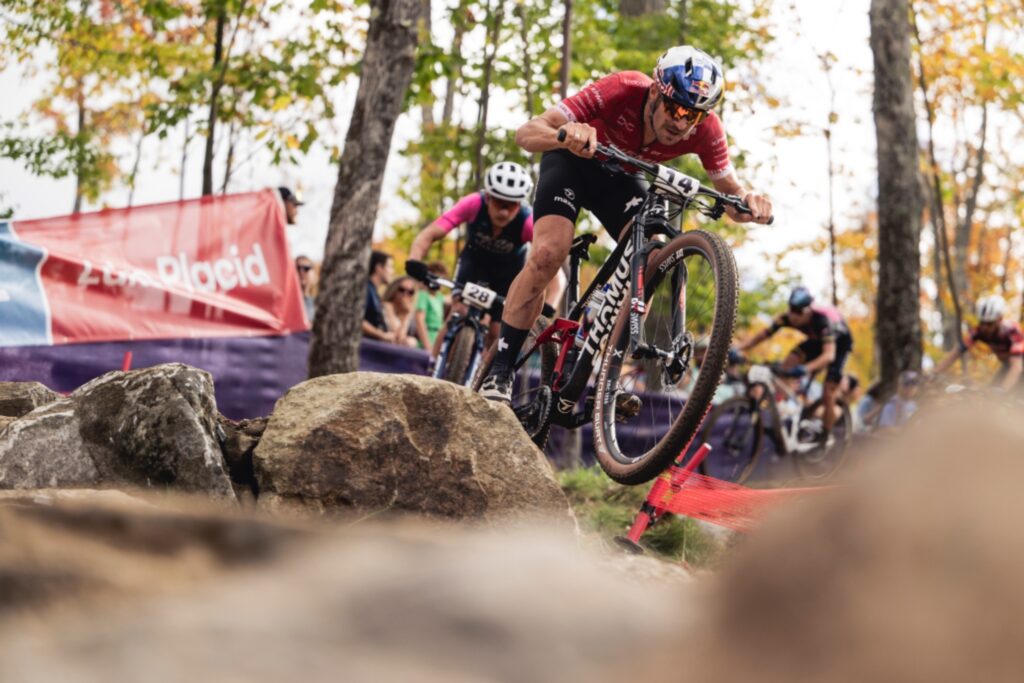
Either way, it has a role. It keeps us engaged. It reminds us that mountain biking isn’t supposed to be easy. It’s supposed to be dynamic, unpredictable, and occasionally uncomfortable. A bit like life itself, really.
Fear is a good thing. It means you’re still being challenged, and it’s what stops us from switching off on descents. It’s what makes those breakthroughs feel more meaningful, and it’s one of the biggest factors in why this sport can feel so rewarding.
Read more X Factor articles from Ella Bloor
– Preserving mountain biking’s Wild heart
– Why N+1 actually makes sense
– How to nurture good MTB culture